Friday, October 4, 2013

The Zambezi Queen on the Chobe River

The Zambezi Queen

We were a tired bunch as we approached our new home in the setting sun. The scheduled six hour trip from Johannesburg had turned into a much longer one, mainly due to long, slow immigration procedures in Zimbabwe and border crossings in Botswana and Namibia, and we were now faced with much hotter weather.

Kilimanjaro and the Serengeti, while much closer to the equator, are at 6,000 to 7,000 feet elevation and the climate is temperate. That's not the case on the Chobe were the average temperature in September is 112 and in October and November it's 120. They call October and November the suicide months because of the unrelenting heat. Somehow I had not researched that in our pre-trip research and Kathy was questioning more than my sanity as we knew the electricity on the boat went off at 10 PM and did not get turned back on until 6 AM.

We had booked a suite at the front of the ship and that would at least give us a balcony and maybe some breeze, but as we were getting our boarding briefing we found out that the ship moored at night: so much for a breeze. Our suite was small and compact, but nicely appointed. The bow balcony pretty spartan, but the view would be great.


The real draw of the ship was the third floor communal area. It was here that we had cocktails, all meals  and just relaxed. It was a very special place and the camaraderie of our new found friends made it even more so.


With the sun setting we got ready for our first dinner on board and wondered what the next four days would bring. It would be pretty hard to top what we had already experienced.


Tuesday, October 1, 2013

Leaving Serengeti......


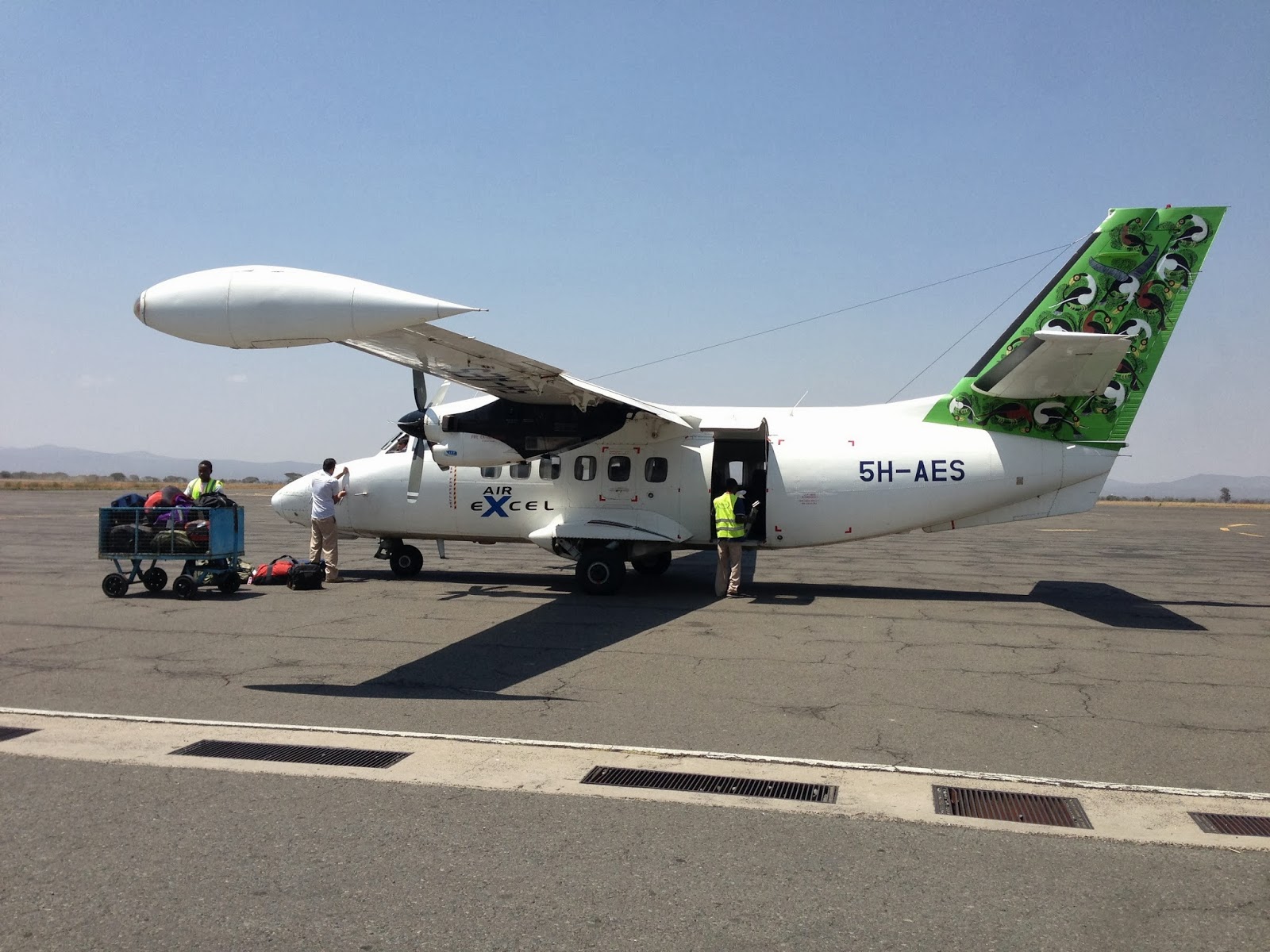
It's time to leave the Serengeti and head to the Chobe River and the Zambezi Queen. We awoke at 6:00 in the morning for what would be an arduous day of travel to Johannesburg, South Africa. We had travelled to the Serengeti on a slightly larger bush plane, but this was to be our transportation to Kilimanjaro International Airport where we would transfer to another plane for the trip to Nairobi. In the bush you get a single engine, dirt runway and a pilot named Steve. At Kilimanjaro, we were upgraded to a paved runway, two engines and a co-pilot as well. 


At Nairobi, it would be a 737 to Johannesburg and a night at the Intercontinental Hotel at the airport.  It all sounds like the trip would only get better with each stop, but in reality the best layover was at Kilimanjaro, a nice, clean, small airport with great wi-fi; the worst, the four hours we spent in hot, stuffy, crowded Nairobi, We finally arrived in Joberg at midnight and by the time we cleared customs and walked across the street to the hotel, checked in and got to our rooms it was one. We left the next morning at ten to face another six hours of travel.

As inconvenienced and stressed as we may have been, our day was pretty easy compared to the daily life of the vast majority of people we saw in Kenya and Tanzania and would see in the remaining countries. What we saw has been haunting me for awhile and I wanted to take some time to show village life.  In the cities, there are cars, congestion, careers and the chaos one finds in all large cities third world country or not, but in the villages it is dirt roads, walking everywhere, hand to mouth existence, and no services except what's provided by aid groups.

This is a typical village road. The paved one is a few miles away.

Store fronts in a small village.

Storefronts in a larger village.

The people do have a sense of humor.
No matter if the roads are paved or not, one sees few cars, an occasional motorbike, a rare tuk-tuk, but people walking everywhere. 

A Maasai. The men, no matter their age, always carry a stick, used for fighting or fending off animals. 
Off to collect fresh water. How far will they walk?

Mother and child
Moving goods is no easier even if the roads are paved.

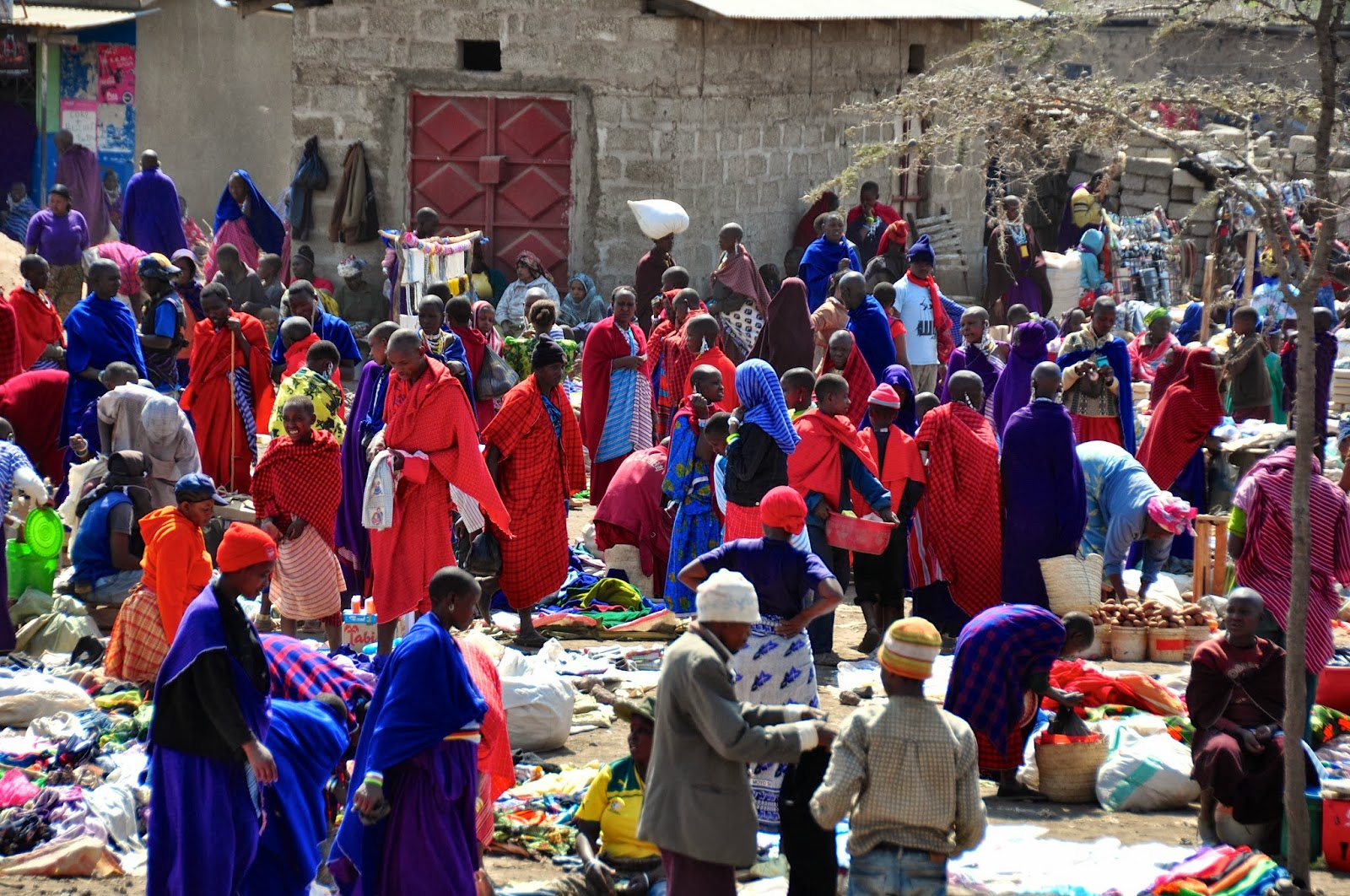
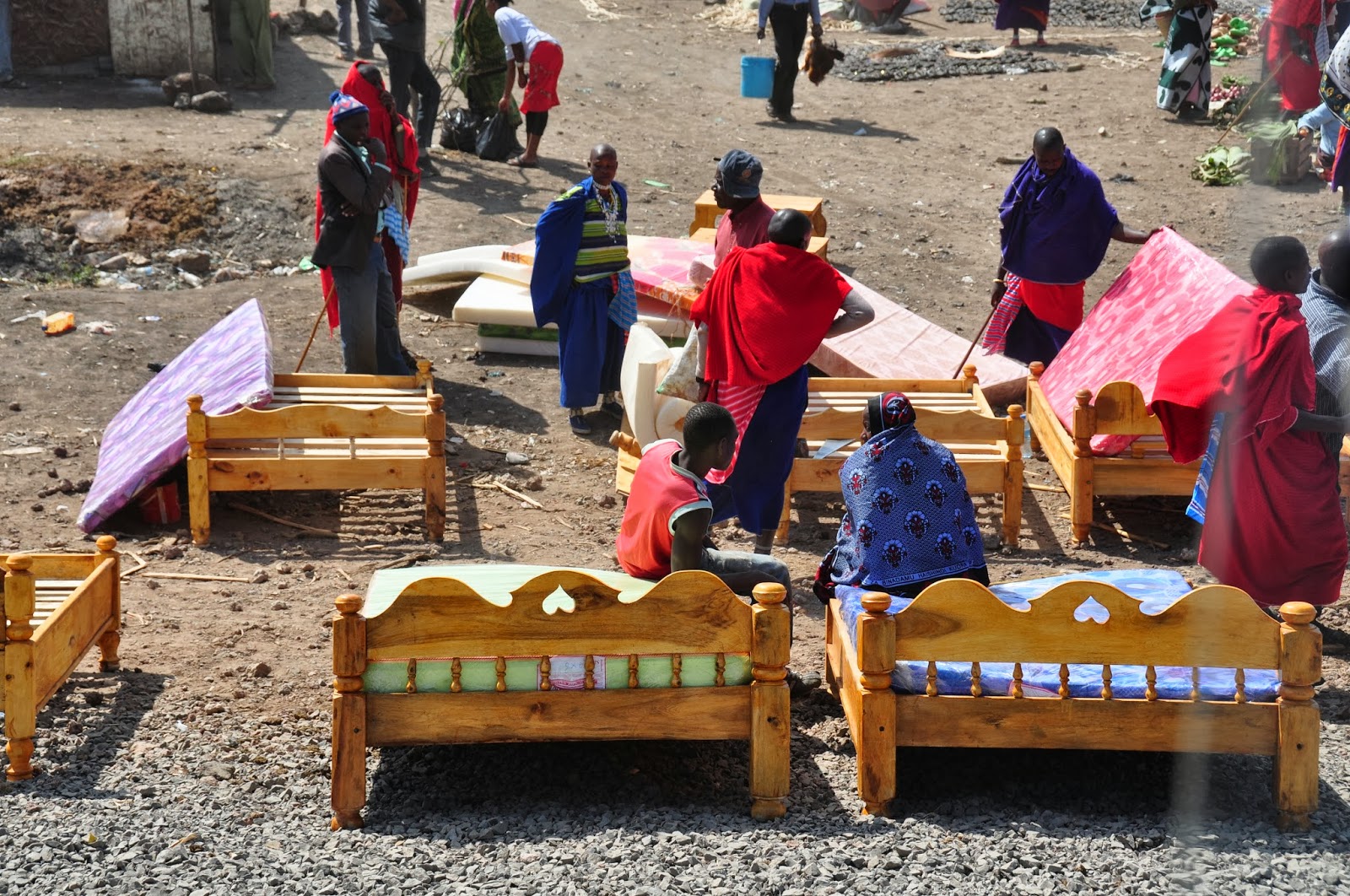
In the subsistence or vendor economy most people live in, it's all about selling anything, anywhere by the road or in roadside markets to exist. The first three pictures are from the regional city Arusha.

The next photos are from a thriving Maasai market on the to Amboseli National Park in Kenya.


The butcher  shop. Refrigeration does not exist for most.

They sell just about everything.
Those of you who have been reading my posts know how touched we were in Cambodia by the people. The same goes for India, but their per capita income is, respectively, $2,400 and $3.900 per year. In Zimbabwe it's $600, in Tanzania, $1,600, in Zambia, $1,700, in Kenya, $1,800. If nothing else, travel certainly heightens one's respect for the resilience of the people who survive on so little. You can not visit these places and leave untouched.

Tuesday, September 24, 2013

Where we have...Serengeti part 2

One can easily become obsessed with getting the perfect animal shot to the point of missing so many of the other wonders of the Serengeti or even Africa itself. There is the rush to see the Big Five or the uniqueness of seeing so many of the animals we grow up knowing only from behind bars in zoos or in pictures in books suddenly a few feet a way from you. They clearly are the stars of the show, but there is so much going on around one that I thought I'd devote this post to some lesser known actors in the magnificent performance that goes on daily.

The trees of the bush are under constant attack and have devised some ingenious ways to survive.

This tree is the Whistling Thorn Acacia. There are tiny little balls hanging from the tree that look like berries. When the animals try to eat them, stinging ants come out of the berries to deter the animals from having a snack. There are also three inch thorns on these trees that help deter grazing, but when the wind blows, a whistling sound from them is made and thus the name.

This is the Umbrella Acacia. It is a symbol of Africa. When it is low and young, it has the same three inch thorns the the Whistling Tree has, but as it grows taller and matures it looses the the thorns and concentrates on leaf production. The animals help give it it's shape by grazing as it grows.
This is the Candelabra Tree. The sap from it is poisonous and causes severe blistering when in contact with the skin and if gotten the eyes it will cause blindness. It also have formidable thorns. Neither animals nor humans go near this one.
The Serengeti is a birders paradise as are most of the National Parks in Africa. Here's a few.
A spoon bill and Marabill Storks.
 
A Fish Eagle.
 
An ostrich family.
 
Vultures.
The little guy below is a hyrax. These things were everywhere in the Tented Camp and were pretty fearless when approached by humans. They look like rodents, but have more in common with elephants and are in the same classification family. We had a lot of fun watching them.
This is tsetse fly trap. They are attracted to the color blue and the traps were all over camp. Their bite really hurts and causes swelling as a few members of our group found out. Fortunately the ones we encountered didn't carry sleeping sickness.
Then there are the antelopes. This is an eland, the largest.
The picture is a little dark, but this is a disk-dik, the smallest.
Finally a serval cat out in the daylight. They are one of the smallest cats in Africa.
There is much to see when one is out on a game drive it can almost become overwhelming and you see so many animals you would think you might become blasé, but as soon as one appears the cameras start clicking whether it is your first day out or last, for you never know when you are going to get that special shot.


.


Sunday, September 22, 2013

Where we have been, The Serengeti

The Serengeti. How does one capture the magnificence of this place? In the Maasai language it roughly means the land that runs forever and standing and looking around that is an apt description. As far back as 1921 the British realized the uniqueness of this area and set aside 800 acres as a preserve. Serengeti did not become a full national park until 1951.
The park itself covers 5,700 square miles of grasslands, savannas, and forests. The only humans allowed to live in the park are the rangers, hotel workers and the visiting tourists. The Maasai were forcibly relocated in 1959.
The park is home to the largest animal migration in the world with 1.5 million wildebeests and 250,000 zebras crossing the Mara River to follow the rains. Uncounted numbers of crocodiles feed on them as they cross. In addition, there are over 5,000 lions, 1,000 leopards, numerous elephant herds, cheetahs, giraffes, well you get it. The place is loaded with animals except for the black rhino. It is estimated that only 12 remain in the park due to rampant poaching of them for their horns. The Asians, particularly the Chinese, are responsible for this. We were fortunate to see one.

One of the primary reasons to come here is to see the migration. We awoke early and headed out for the three hour trip to get to the Mara River. The wildebeest and the zebras mass on the shores of the river. The wildebeest skittishly approach the banks waiting for someone to cross. The move to the banks and move back. This goes on and on. We watched for two hours and no one crossed. Thus, we didn't see the real migration. Why the skittishness? They know that the first ones in will be eaten by the crocodiles. The zebras patiently wait for the wildebeests to start before they cross.
Some wildebeests crossing a small stream.
 
A small portion of the herd waiting on the river bank. The herd literally stretched for hundreds of yards.


A crocodile waiting on the banks for dinner. Can you see why the wildebeest are skittish? There are hundreds of these guys waiting for them.

The day was not a total waste however as we got to see our first cheetahs. They look to sit on the many rock outcroppings called koptjes that dot the plains looking for prey and that was were we found a pair. Regretfully this app is not working properly so I can't use some closer shots, but I think this silhouette gives you an idea of the power contained in the world's fastest animal.
Having seen a black rhino, the bunching of animals for the migration and the cheetahs, we were a tired, but pretty happy group. As a final gift at the end of the day our driver got us up close to a male lion. As you can see he was pretty content to let us just shoot away, but as close as we were, it was nothing compared to what Kathy would experience a few days later.
So we returned to the camp as the sun disappeared from the sky, tired, but pretty happy with what we saw. We knew cocktails, a great meal and a comfortable bed were ahead. It was a great day.
This was to be our home for the next three nights.


This tent had solar hot water and twenty four hour electricity. It was not far from a river from which one could hear the hippos at night, not to mention all the other animals. There was no fence, nor outside lights, so once the sun went down a guard escorted you to wherever you wanted to go and he was armed.
We settled in after dinner in the comfortable bed and promptly fell asleep. At three o'clock in the morning we both were jolted awake from the tent shaking like we were in an earthquake. It only lasted ten seconds or so, but neither of us wanted to open the door to see what happened. When we went for breakfast in the morning, there were elephants around the tent. Our guide surmised that one must have decided to scratch itself against the porch causing the shaking. Welcome to the Serengeti !